Why Hyperke
Your campaigns benefit from 8 million emails a month.Even if you don't send that many.
Anyone can buy the same sending software, contact databases, and AI tools we use. Having the same tools doesn't give you the same knowledge.
We send over 8 million cold emails every month across hundreds of industries. Every send, reply, and conversation teaches us something about what works. We use those lessons on your campaigns.
8M+
Cold emails / month
We know what's working before your first email goes out.
Better deliverability starts with better data.
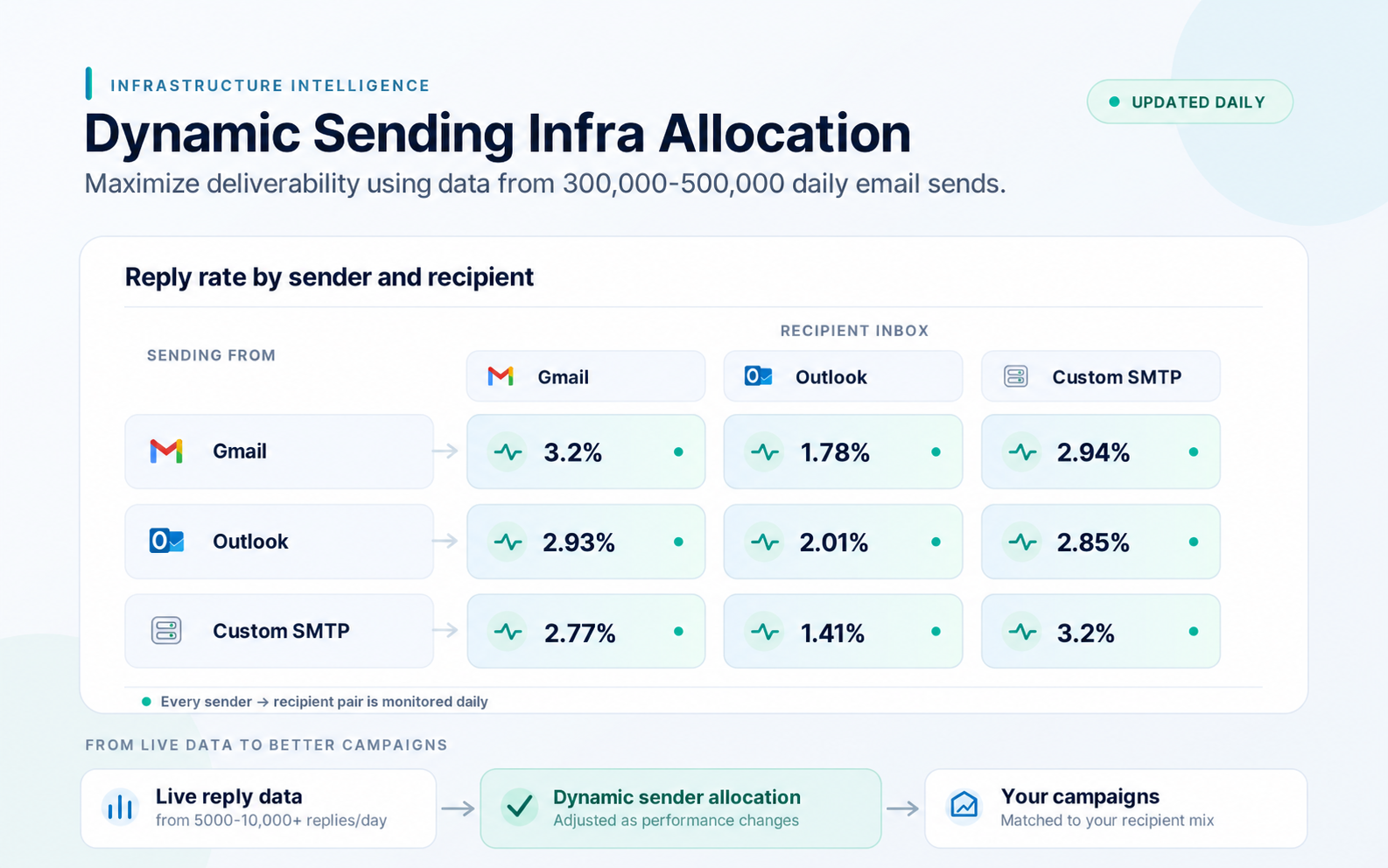
Sending infrastructure doesn't all perform the same. An email sent from a Google Workspace inbox to an Outlook recipient can do very differently from one sent through SMTP to that same recipient. Those differences keep changing.
We track reply rates across nine sending routes. You can send from Google, Outlook, or SMTP, and each of those can send to Google, Outlook, or custom SMTP.
With hundreds of thousands of emails going out daily, we see changes on these routes much faster than a team that only has its own campaigns to look at.
For you, that means we check which email providers your target accounts use before launch. We assign sending infrastructure based on current performance data, and we change that assignment as results shift. Other teams may need weeks of campaign data, or a monthly vendor report, to spot the same changes.
We don't need your campaigns to fail to find out what isn't working.
We find people that contact databases don't know about.
Our best contact data comes from replies, not from Apollo or ZoomInfo.
We get thousands of replies a day. Some are positive and some are negative. Some contain information no contact database has.
Take an out-of-office reply:
“I'm away this week. For anything related to partnerships, please contact Sarah at sarah@company.com.”
That one reply gave us a new contact, a verified email address, and what that person handles.
Replies sometimes include direct phone numbers or referrals to other decision-makers. Across millions of emails, that adds up. We keep finding relevant people who aren't in conventional databases. Where appropriate, we verify that information and use it to improve our targeting.
Your campaigns can reach people your competitors don't know exist.
Automatic reply
Out of office
I'm away this week. For anything related to partnerships, please contact Sarah at sarah@company.com.
Contact discovered
First-party signalName
Sarah
sarah@company.com
Function
Partnerships
Illustrative example. Contact details are checked before use.
Our copywriting is backed by millions of real conversations.
We study what makes people reply instead of guessing.
Every day we get hundreds of positive replies across different industries, job titles, and buyer personas. We use AI to find patterns in those conversations. Which opening lines get attention? Which questions get people talking?
Some findings surprise us. A simple, direct email sometimes beats a carefully written pitch. Changing one question can change how prospects respond. What sounds persuasive isn't always what gets replies, and what works for one audience may fail for another.
So we combine what we've learned across campaigns with new tests built for your market.
Our recommendations come from what buyers actually respond to, not from what a copywriter thinks should work.
Reply intelligence
Patterns across campaigns
Positive replies
What gets buyers to engage
Recurring language
How people describe their needs
Message patterns
Which approaches deserve testing
Test the strongest patterns against your market.
Conceptual workflow. No sample results are implied.
We turn interested replies into booked meetings. Fast.
An interested reply isn't a booked meeting.
You could have the best targeting, infrastructure, and copy. If someone replies with interest and nobody follows up for six hours, you've wasted the opportunity.
That's why we have a dedicated team of human SDRs. When a prospect replies, they can engage within minutes. They answer questions, call, text where appropriate, qualify, follow up, and get meetings on your calendar. We don't forward an interested reply and leave the rest to you.
Speed matters. A 2007 InsideSales.com/MIT study of web-generated leads found that calling within five minutes, rather than thirty, was associated with 100x higher odds of making contact and 21x higher odds of qualifying the lead.
The study looked at inbound web leads, not cold-email replies. It still shows why response time deserves serious attention. We build fast, human follow-up into the system.
From reply to meeting
Human-ledInterested reply
A prospect responds to your outreach.
Human response
An SDR takes the conversation forward.
Call or text
The team follows up when appropriate.
Qualify and book
A qualified meeting reaches your calendar.
100x
Higher odds of contact
21x
Higher odds of qualification
Findings from a 2007 study of inbound web leads comparing 5-minute and 30-minute response times.
The compounding advantage
Every campaign adds to what we know.
Most outbound teams only learn from the campaigns they run themselves. We learn from hundreds of industries, millions of emails, and thousands of conversations. Each month that gives us more to improve:
Where and how we send emails.
Who we contact.
What we say.
How we turn interest into meetings.
A solo practitioner or an in-house GTM engineer can build a great outbound system. Reproducing years of first-party data, this volume of feedback, and a full SDR operation is a much bigger job.
You don't have to send 8 million emails to benefit from what we've learned by sending them.
Let's talk about your market.
Apply for our Outbound Pilot and in 7 days, you will find out exactly how much revenue outbound can drive for you.
Apply for our Outbound Pilot